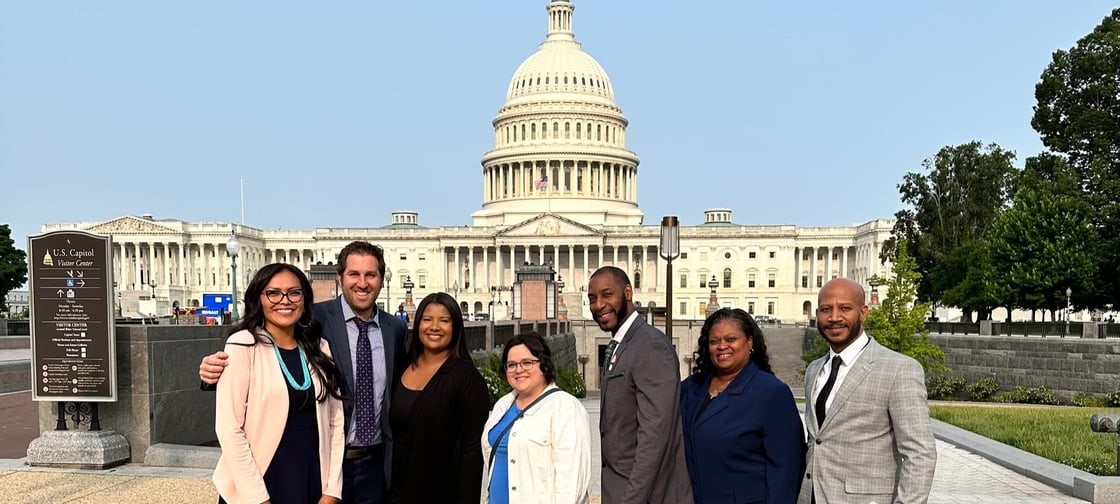
During National Charter Schools Week, we celebrate achievements in the school house and the state house. These achievements could not have been possible without the commitment of teachers, leaders, parents and advocates from all parts of the country. We asked some of these individuals to tell us why they are a part of the charter schools movement.
After earning my teaching degree, I spent a year as a substitute teacher. To say that that was an unrewarding experience would be an understatement. By the end of that year, after multiple applications to school districts around Rhode Island, I found myself without a single interview. I expanded my search to include community-based organizations and was soon hired to teach computers to unemployed and underemployed adults. Eventually, I would be designing employment training programs for adults and teens whose families were struggling to make ends meet. This position allowed me to hone many of the skills that would later serve me well as a public school teacher. After four years in this position, I found myself longing to continue my education. I moved to Southern California to pursue a masters in screenwriting. This is what I often called a personal enrichment degree. In addition to teaching, my other passion was independent filmmaking. While pursuing this degree, I took a job as an administrator in a proprietary school in the Los Angeles area. While this work seems a long way from teaching in a public school, many of the students enrolling in proprietary schools are those who achieved less success while they were in high school. Reaching them and ensuring their success motivated me every day. Family matters brought me back to Rhode Island and a community-based organization. Within a couple of years, Beacon Charter School opened down the street and I got myself an interview. I include this employment history as a way to shed light on one of the great things about charters. While charters serve as a second chance for students to be successful, I feel that the faculty and staff of the schools are no different. I was certainly never a failure as a public school teacher; I was never given the chance to be one. That is, of course, until I was hired at Beacon as a social studies teacher. In eight years at Beacon, I went from teaching all levels of history and civics courses to creating the school’s performance-based graduation system (including digital portfolios and an innovative senior film requirement for all students), serving an internship as principal-in-residence and, finally, this past year, being appointed principal and earning my doctorate. For me, charter schools will always represent opportunity; an opportunity for adults to make a difference in the lives of students and for students to explore skills and talents they didn’t know they had. Many of our students could be classified as small fish in the big ponds of traditional public schools. At a charter school, they are in a smaller pond with a better chance for engaging with key aspects of the high school experience. Many of my teachers have never been given the opportunity to use their talents in traditional public schools. Their reward for getting hired at a charter school: greater freedoms to implement standards-based instruction. The cost: greater accountability for the teaching and learning at the school. This is true for charter schools in general: greater freedoms and increased accountability. None of us would have it any other way. For more information on Beacon Charter High School for the Arts, please visit www.beaconart.org. Michael Skeldon, Ed.D. is the Principal of Beacon Charter High School for the Arts in Woonsocket, RI. Beacon Charter High School for the Arts students in the theater arts program.